Introduction
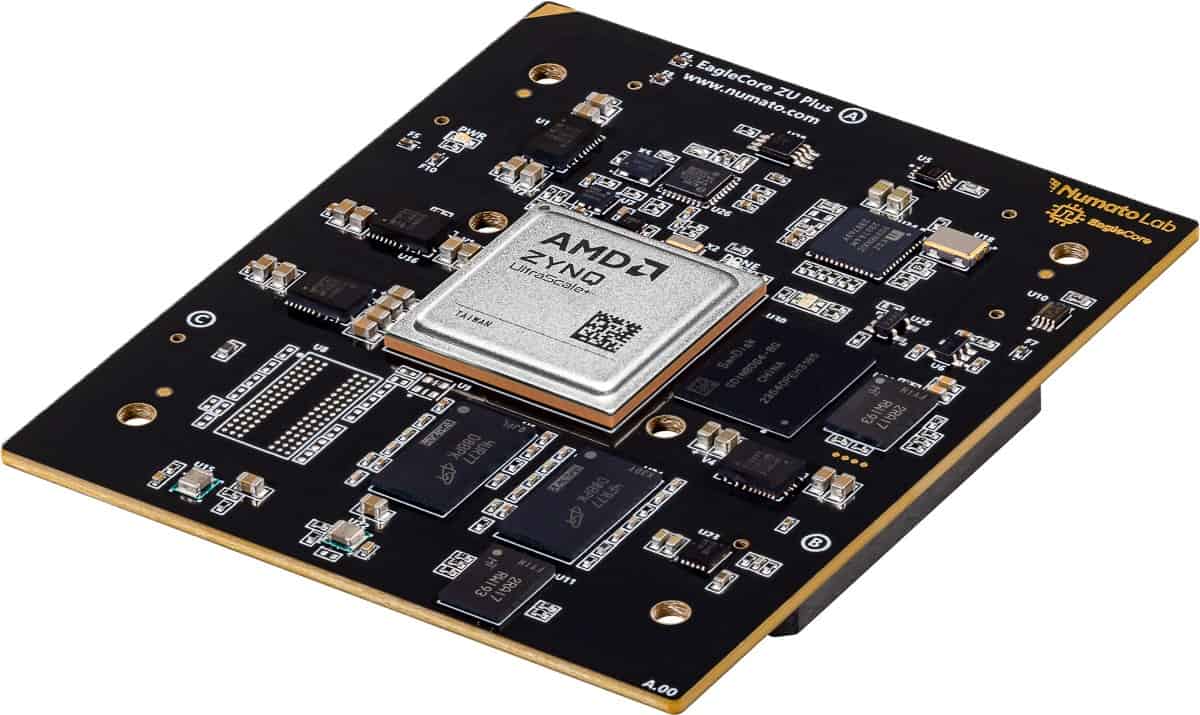
The EagleCore ZU-Plus MPSoC SOM, which uses the part number XCZU3TEG-1SFVC784I, belongs to the UltraScale+ MPSoC family developed by AMD. This series also includes compatible part numbers such as XCZU3TCG-1SFVC784I, XCZU3CG-1SFVC784I, XCZU3EG-1SFVC784I, and XCZU4EV-1SFVC784I. These SoCs combine the processing power of multiple ARM Cortex-A processors with the programmable logic fabric of a field-programmable gate array (FPGA), offering robust performance and flexibility for a wide range of applications.
Additionally, the EagleCore ZU-Plus MPSoC SOM includes RTC (Real-Time Clock) functionality, ensuring precise timekeeping for applications requiring accurate time management. This combination of ARM processing capabilities, FPGA programmable logic, and RTC functionality makes it particularly well-suited for fields where high performance and versatility are crucial.
AMD provides a comprehensive development ecosystem, including the Vivado Design Suite and the Vitis unified software platform, which allows developers to effectively leverage both the ARM and FPGA components and PetaLinux designed for building, customizing, and deploying embedded Linux systems.
Board features
- Device: Zynq UltraScale+™ MPSoC.
- SDRAM: 2GB DDR4.
- Oscillator: 33.33 MHz (PS), 100MHz (PL).
- eMMC: 8GB Storage (expandable up to 64 GB).
- Flash Memory: Dual parallel 1Gb SPI flash memories.
- 1 x Gigabit Ethernet PHY.
- USB-OTG PHY.
- EEPROM.
- 4 x High speed GTR lanes.
- 3 x Q PAIRS DIFFERENTIAL PAIR MEZZANINE CONNECTORS. (QTH-060-02-L-D-A)
- Programming & Debugging: JTAG programming, USB Programming.
- 1 RGB LED for custom use.
- IOs for user-defined purposes XCZU3TEG & XCZU3TCG
- HP – 46 IOs
- HD – 63 IOs
- MIO – 9 IOs
- GTH – 4
- IOs for user-defined purposes XCZU3EG & XCZU3CG – available on-demand (For enquiries, please contact us).
- HP – 92 IOs
- HD – 63 IOs
- MIO – 9 IOs
- IOs for user-defined purposes XCZU4EV-1SFVC784I – available on-demand (For enquiries, please contact us).
- HP – 92 IOs
- HD – 63 IOs
- MIO – 9 IOs
- GTH – 4
Application
- Product Prototype Development
- Accelerated computing integration
- Custom Embedded platform
- Signal Processing
- Communication devices development
- Educational tool for Schools and Universities
Components/Tools required
Along with the module, you may need the items in the list below for easy and fast installation.
- Eaglecore ZUC02 Carrier or Eaglecore ZUC03 Carrier.
- USB-C cable
- AMD Platform Cable USB or compatible JTAG programmer. (optional)
- DC Power supply (12V).
Wiring Diagram
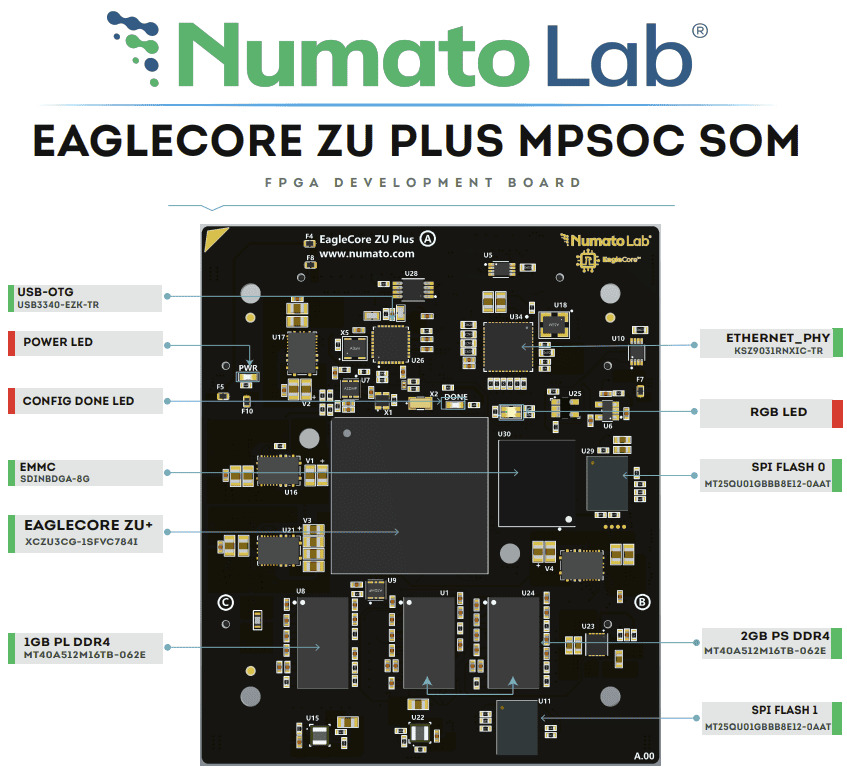
Reference clock
Bank Signal name FPGA Pin Function
66 CLK_P D4
100MHz Fabric Clock
66 CLK_N C4
64 DDR_CLK0_P AE5
DDR Reference Clock 100MHz
64 DDR_CLK0_N AF5
224 GTH_CLK_00_P Y6
GTH Clock
224 GTH_CLK_00_N Y5
Reset
Bank Pin No. Signal name Function
503 N19 PS_SRST_B Dev RESET
503 P16 PS_POR_B PROG_B
24 Y12 IO_RESET IO_RESET
DDR4 SDRAM
DDR4 SDRAM is the fourth-generation Double Data Rate synchronous dynamic RAM technology, designed to provide higher memory bandwidth and improved power efficiency compared to DDR3/DDR3L. The Zynq UltraScale+ module uses two DDR4 SDRAM devices (MT40A512M16T), operating at a reduced core voltage of 1.2 V, enabling faster data transfer and reliable high-speed system performance.
PLDDR4 SDRAM
DDR4 SDRAM is also provided on the PL DDR interface to support high-bandwidth memory access from the Programmable Logic (PL). This PL DDR4 memory consists of DDR4 SDRAM device (MT40A512M16T) and enables faster data transfer and efficient external buffering for PL-based applications. The PL DDR4 interface is connected to Bank 64, and Bank 64 is available only in the XCZU3CG-1SFVC784I and XCZU3EG-1SFVC784I variants.
UART
The EagleCore ZU+ board supports UART pins connected to PS Bank 501 and operates at 1.8 V I/O voltage.
BANK FPGA PIN Signal Name Function
501 L18 PS_MIO42 UART RX
501 K19 PS_MIO43 UART TX
QSPI Flash
The EagleCore ZU+ board features dual parallel QSPI flash memory (MT25QU512ABB8E12) with a total capacity of 1 Gb. It is a serial NOR flash that operates at 1.8 V and is connected to the PS QSPI interface via Bank 500, serving as the default primary boot device.
Bank FPGA Pin Signal Name Function
500 AG15 PS_MIO0 QSPI0_SCK
500 AG16 PS_MIO1 QSPI0_DQ1
500 AF15 PS_MIO2 QSPI0_DQ2
500 AH15 PS_MIO3 QSPI0_DQ3
500 AH16 PS_MIO4 QSPI0_DQ0
500 AD16 PS_MIO5 QSPI0_SS
500 AH17 PS_MIO7 QSPI1_SS
500 AF17 PS_MIO8 QSPI1_DQ0
500 AC16 PS_MIO9 QSPI1_DQ1
500 AD17 PS_MIO10 QSPI1_DQ2
500 AE17 PS_MIO11 QSPI1_DQ3
500 AC17 PS_MIO12 QSPI1_SCK
SD card
The EagleCore ZU+ board includes a microSD card interface that can be used as non-volatile external storage and also as an option for secondary booting. The SD card is connected to the PS interface via Bank 501 and operates at 1.8 V. The SD card can be accessed through the microSD card connector on the board.
Bank FPGA Pin Signal Name Function
501 L20 PS_MIO46 SD_DATA0
501 H21 PS_MIO47 SD_DATA1
501 J21 PS_MIO48 SD_DATA2
501 M18 PS_MIO49 SD_DATA3
501 M19 PS_MIO50 SD_CMD
501 L21 PS_MIO51 SD_CLK
eMMC
The EagleCore ZU+ board includes an on-board eMMC flash (SDINBDG4-8G) that provides non-volatile mass storage for applications such as OS boot, file storage, and data logging. The eMMC device is connected to the PS interface via Bank 500 and operates at 1.8 V I/O voltage. In addition to storage, the eMMC can also be configured as a boot source, allowing the system to boot directly from the eMMC device.
Bank FPGA Pin Signal Name Function
500 AH18 PS_MIO13 eMMC_DATA0
500 AG18 PS_MIO14 eMMC_DATA1
500 AE18 PS_MIO15 eMMC_DATA2
500 AF18 PS_MIO16 eMMC_DATA3
500 AC18 PS_MIO17 eMMC_DATA4
500 AC19 PS_MIO18 eMMC_DATA5
500 AE19 PS_MIO19 eMMC_DATA6
500 AD19 PS_MIO20 eMMC_DATA7
500 AC21 PS_MIO21 eMMC_CMD
500 AB20 PS_MIO22 eMMC_CLK
500 AB18 PS_MIO23 eMMC_RST_n
Ethernet
USB 2.0 OTG
The EagleCore ZU+ board supports high-speed USB 2.0 On-The-Go (OTG) functionality using the USB3340 ULPI transceiver with a 24 MHz operating frequency. It supports both USB device and host modes (default Host mode). The ULPI (UTMI+ Low Pin Interface) protocol is used to interface the PS MIO pins with the PHY device. The USB OTG interface is connected to PS Bank 502 and operates at 1.8 V I/O voltage.
The VBUS and USB ID pins are used to determine whether the OTG operates in Host mode, Device mode, or OTG mode.
Bank FPGA Pin Signal Name Function
502 G18 PS_MIO52 USB_CLK
502 D16 PS_MIO53 USB_DIR
502 F17 PS_MIO54 USB_DATA2
502 B16 PS_MIO55 USB_NXT
502 C16 PS_MIO56 USB_DATA0
502 A16 PS_MIO57 USB_DATA1
502 F18 PS_MIO58 USB_STP
502 E17 PS_MIO59 USB_DATA3
502 C17 PS_MIO60 USB_DATA4
502 D17 PS_MIO61 USB_DATA5
502 A17 PS_MIO62 USB_DATA6
500 AB19 PS_MIO25 USB_RST
MAC EEPROM
The EagleCore ZU+ features a MAC ID EEPROM, which is a non-volatile memory device used to store the unique MAC address of the Ethernet interface. It is connected to the PS MIO interface via Bank 501 and operates at 1.8 V I/O voltage.
Bank FPGA Pin Signal name Function
501 H18 PS_MIO38 I2C_SCL
501 H19 PS_MIO39 I2C_SDA
CAN
The EagleCore ZU+ supports CAN communication through the PS CAN controllers, providing a reliable interface for connecting to external devices using the CAN protocol. It offers dual CAN support through the CAN0 and CAN1 interfaces, connected via PS Bank 501, and operates at an I/O voltage of 1.8 V.
Bank FPGA Pin Signal Name Function
501 L17 PS_MIO34 CAN0_RX
501 H17 PS_MIO35 CAN0_TX
501 K17 PS_MIO36 CAN1_RX
501 J17 PS_MIO37 CAN1_TX
Real Time Clock
Zynq UltraScale+ MPSoC includes an on-chip Real-Time Clock (RTC) that maintains accurate date and time information independently of the main system operation. The RTC can be backed up using the VBAT (coin-cell battery) input, allowing the date and time to be preserved even when the board is powered OFF, as long as the battery is installed.
RGB LED
The EagleCore ZU+ board includes an RGB LED for user indication and general-purpose applications. It is connected to HD Bank 24 and operates at an I/O voltage of 3.3 V.
Bank FPGA Pin Signal Name Function
HD_24 AF13 IO_L4N_AD12N_24 LED0
HD_24 AD15 IO_L5P_HDGC_24 LED1
HD_24 AD14 IO_L5N_HDGC_24 LED2
SOM Connectors
Connector P1
Pin No. Signal Name Pin Name FPGA pin Pin No Signal Name Pin Name FPGA pin
1 VDD1V8 VCC1V8 2 VCC3V3 VCC3V3
3 VDD1V8 VCC1V8 4 VCC3V3 VCC3V3
5 GND GND 6 GND GND
7 CLK0_P GTR_CLK_00_P F23 8 CLK1_P GTR_CLK_01_P E21
9 CLK0_N GTR_CLK_00_N F24 10 CLK1_N GTR_CLK_01_N E22
11 GND GND 12 GND GND
13 RX0_P GTR_RX_00_P F27 14 TX0_P GTR_TX_00_P E25
15 RX0_N GTR_RX_00_N F28 16 TX0_N GTR_TX_00_N E26
17 GND GND 18 GND GND
19 RX1_P GTR_RX_01_P D27 20 TX1_P GTR_TX_01_P D23
21 RX1_N GTR_RX_01_N D28 22 TX1_N GTR_TX_01_N D24
23 GND GND 24 GND GND
25 RX2_P GTR_RX_02_P B27 26 TX2_P GTR_TX_02_P C25
27 RX2_N GTR_RX_02_N B28 28 TX2_N GTR_TX_02_N C26
29 GND GND 30 GND GND
31 RX3_P GTR_RX_03_P A25 32 TX3_P GTR_TX_03_P B23
33 RX3_N GTR_RX_03_N A26 34 TX3_N GTR_TX_03_N B24
35 GND GND 36 GND GND
37 CLK2_P GTR_CLK_02_P C21 38 CLK3_P GTR_CLK_03_P A21
39 CLK2_N GTR_CLK_02_N C22 40 CLK3_N GTR_CLK_03_N A22
41 GND GND 42 GND GND
43 RX4_P GTH_RX_00_P Y2 44 TX4_P GTH_TX_00_P W4
45 RX4_N GTH_RX_00_N Y1 46 TX4_N GTH_TX_00_N W3
47 GND GND 48 GND GND
49 RX5_P GTH_RX_01_P V2 50 TX5_P GTH_TX_01_P U4
51 RX5_N GTH_RX_01_N V1 52 TX5_N GTH_TX_01_N U3
53 GND GND 54 GND GND
55 RX6_P GTH_RX_02_P T2 56 TX6_P GTH_TX_02_P R4
57 RX6_N GTH_RX_02_N T1 58 TX6_N GTH_TX_02_N R3
59 GND GND 60 GND GND
61 RX7_P GTH_RX_03_P P2 62 TX7_P GTH_TX_03_P N4
63 RX7_N GTH_RX_03_N P1 64 TX7_N GTH_TX_03_N N3
65 GND GND 66 GND GND
67 CLK4_P GTH_CLK_01_P V6 68 LED/LINK LED/LINK
69 CLK4_N GTH_CLK_01_N V5 70 LED/ACT LED/ACT
71 GND GND 72 GND GND
73 GPHY_A1_P GPHY_ATXRX_P 74 GPHY_C1_P GPHY_CTXRX_P
75 GPHY_A1_N GPHY_ATXRX_N 76 GPHY_C1_N GPHY_CTXRX_N
77 GND GND 78 GND GND
79 GPHY_B1_P GPHY_BTXRX_P 80 GPHY_D1_P GPHY_DTXRX_P
81 GPHY_B1_N GPHY_BTXRX_N 82 GPHY_D1_N GPHY_DTXRX_N
83 GND GND 84 GND GND
85 CAN0_TX CAN0_TX H17 86 CAN1_TX CAN1_TX K17
87 CAN0_RX CAN0_RX L17 88 CAN1_RX CAN1_RX J17
89 GND GND 90 GND GND
91 PS_ERROR_STATUS PS_ERROR_STATUS M20 92 V_P V_P T12
93 PS_ERROR_OUT PS_ERROR_OUT P17 94 V_N V_N R13
95 VBAT VBAT Y18 96 PROG_B PROG_B R17
97 MIO MIO_31 H16 98 PRSNT_L PRSNT_L AG13
99 GND GND 100 GND GND
101 IO0_P MIO_27 J15 102 IO1_P MIO_44 J20
103 IO0_N MIO_28 K15 104 IO1_N MIO_45 K20
105 IO2_P MIO_29 G16 106 IO3_P MIO_32 J16
107 IO2_N MIO_30 F16 108 IO3_N MIO_33 L16
109 GND GND 110 GND
111 IO4_P HD_26_CC_P AC14 112 IO5_P HD_28_CC_P AB15
113 IO4_N HD_26_CC_N AC13 114 IO5_N HD_28_CC_N AB14
115 IO6_P HD_27_CC_P AA13 116 IO7_P HD_29_P W14
117 IO6_N HD_27_CC_N AB13 118 IO7_N HD_29_N W13
119 GND GND 120 GND GND
Note: Bank 224 is compatible only for the part numbers XCZU3TCG and XCZU3TEG.
Connector P2
Pin No. Signal Name Pin Name FPGA Pin Pin No. Signal Name Pin Name FPGA Pin
1 VIN VIN 2 VIN VIN
3 VIN VIN 4 VIN VIN
5 VIN VIN 6 VIN VIN
7 GND GND 8 GND GND
9 GND GND 10 GND GND
11 VCCO_IO VCCO_HP 12 VDD1V8 VCC1V8
13 VCCO_IO VCCO_HP 14 VDD1V8 VCC1V8
15 GND GND 16 GND GND
17 IO0_P HP66_00_CC_P C1 18 IO1_P HP66_01_CC_P G1
19 IO0_N HP66_00_CC_N B1 20 IO1_N HP66_01_CC_N F1
21 IO2_P HP66_02_P A2 22 IO3_P HP66_03_P E1
23 IO2_N HP66_02_N A1 24 IO3_N HP66_03_N D1
25 GND GND 26 GND GND
27 IO4_P HP66_04_P B3 28 IO5_P HP66_05_CC_P C3
29 IO4_N HP66_04_N A3 30 IO5_N HP66_05_CC_N C2
31 IO6_P HP66_06_CC_P B4 32 IO7_P HP66_07_CC_P B5
33 IO6_N HP66_06_CC_N A4 34 IO7_N HP66_07_CC_N A5
35 GND GND 36 GND GND
37 IO8_P HP66_08_P A7 38 IO9_P HP66_09_P A9
39 IO8_N HP66_08_N A6 40 IO9_N HP66_09_N A8
41 IO10_P HP66_10_P C6 42 IO11_P HP66_11_CC_P C8
43 IO10_N HP66_10_N B6 44 IO11_N HP66_11_CC_N B8
45 GND GND 46 GND GND
47 IO12_P HP66_12_P C9 48 IO13_P HP66_13_P E9
49 IO12_N HP66_12_N B9 50 IO13_N HP66_13_N D9
51 IO14_P HP66_14_P F8 52 IO15_P HP66_15_CC_P E5
53 IO14_N HP66_14_N E8 54 IO15_N HP66_15_CC_N D5
55 GND GND 56 GND GND
57 IO16_P HP66_16_P G5 58 IO17_P HP66_17_CC_P G8
59 IO16_N HP66_16_N F5 60 IO17_N HP66_17_CC_N F7
61 IO18_P HP66_18_CC_P G3 62 IO19_P HP66_19_CC_P D7
63 IO18_N HP66_18_CC_N F3 64 IO19_N HP66_19_CC_N D6
65 GND GND 66 GND GND
67 IO20_P HP66_20_P E4 68 IO21_P HP66_21_P F2
69 IO20_N HP66_20_N E3 70 IO21_N HP66_21_N E2
71 IO22_P HP66_22_P G6 72 IO23_P HP65_01_CC_P W8
73 IO22_N HP66_22_N F6 74 IO23_N HP65_01_CC_N Y8
75 GND GND 76 GND GND
77 IO24_P HP65_00_CC_P L1 78 IO25_P HP65_03_P U9
79 IO24_N HP65_00_CC_N K1 80 IO25_N HP65_03_N V9
81 IO26_P HP65_02_P U8 82 IO27_P HP65_05_CC_P H4
83 IO26_N HP65_02_N V8 84 IO27_N HP65_05_CC_N H3
85 GND GND 86 GND GND
87 IO28_P HP65_04_P R7 88 IO29_P HP65_07_P R6
89 IO28_N HP65_04_N T7 90 IO29_N HP65_07_N T6
91 IO30_P HP65_06_CC_P R8 92 IO31_P HP65_09_CC_P M6
93 IO30_N HP65_06_CC_N T8 94 IO31_N HP65_09_CC_N L5
95 GND GND 96 GND GND
97 IO32_P HP65_08_P J1 98 IO33_P HP65_11_CC_P K4
99 IO32_N HP65_08_N H1 100 IO33_N HP65_11_CC_N K3
101 IO34_P HP65_10_P K2 102 IO35_P HP65_13_CC_P L3
103 IO34_N HP65_10_N J2 104 IO35_N HP65_13_CC_N L2
105 GND GND 106 GND GND
107 IO36_P HP65_12_P J7 108 IO37_P HP65_14_P N7
109 IO36_N HP65_12_N H7 110 IO37_N HP65_14_N N6
111 SD_CLK SD_CLK L21 112 SD_DATA0 SD_DATA0 L20
113 SD_CMD SD_CMD M19 114 SD_DATA1 SD_DATA1 H21
115 UART_RXD UART_RX L18 116 SD_DATA2 SD_DATA2 J21
117 UART_TXD UART_TX K19 118 SD_DATA3 SD_DATA3 M18
119 GND GND 120 GND GND
Connector P3
Pin No Signal Name Pin Name FPGA Pin Pin No Signal Name Pin Name FPGA Pin
1 VIN VIN 2 VIN VIN
3 VIN VIN 4 VIN VIN
5 VIN VIN 6 VIN VIN
7 GND GND 8 GND GND
9 GND GND 10 GND GND
11 VCC3V3 VCC3V3 12 VCC_IO VCCO_HD
13 VCC3V3 VCC3V3 14 VCC_IO VCCO_HD
15 GND GND 16 GND GND
17 IO0_P HD_00_CC_P E10 18 IO1_P HD_01_CC_P E12
19 IO0_N HD_00_CC_N D10 20 IO1_N HD_01_CC_N D11
21 IO2_P HD_02_P D12 22 IO3_P HD_03_P A12
23 IO2_N HD_02_N C12 24 IO3_N HD_03_N A11
25 GND GND 26 GND GND
27 IO4_P HD_04_P B11 28 IO5_P HD_05_P C11
29 IO4_N HD_04_N A10 30 IO5_N HD_05_N B10
31 IO6_P HD_06_CC_P G11 32 IO7_P HD_07_P H11
33 IO6_N HD_06_CC_N F10 34 IO7_N HD_07_N G10
35 GND GND 36 GND GND
37 IO8_P HD_08_P J11 38 IO9_P HD_09_CC_P F12
39 IO8_N HD_08_N J10 40 IO9_N HD_09_CC_N F11
41 IO10_P HD_10_P J12 42 IO11_P HD_11_P K13
43 IO10_N HD_10_N H12 44 IO11_N HD_11_N K12
45 GND GND 46 GND GND
47 IO12_P HD_12_P B15 48 IO13_P HD_13_P B13
49 IO12_N HD_12_N A15 50 IO13_N HD_13_N A13
51 IO14_P HD_14_P B14 52 IO15_P HD_15_P C14
53 IO14_N HD_14_N A14 54 IO15_N HD_15_N C13
55 GND GND 56 GND GND
57 IO16_P HD_16_CC_P D15 58 IO17_P HD_17_CC_P E14
59 IO16_N HD_16_CC_N D14 60 IO17_N HD_17_CC_N E13
61 IO18_P HD_18_CC_P G13 62 IO19_P HD_19_P L14
63 IO18_N HD_18_CC_N F13 64 IO19_N HD_19_N L13
65 GND GND 66 GND GND
67 IO20_P HD_20_P G15 68 IO21_P HD_21_P H14
69 IO20_N HD_20_N G14 70 IO21_N HD_21_N H13
71 IO22_P HD_22_CC_P F15 72 IO23_P HD_23_P K14
73 IO22_N HD_22_CC_N E15 74 IO23_N HD_23_N J14
75 GND GND 76 GND GND
77 IO24_P HD_24_P AE15 78 IO25_P HD_25_P AG14
79 IO24_N HD_24_N AE14 80 IO25_N HD_25_N AH14
81 IO26_P HP65_16_P M8 82 IO27_P HP65_15_P N9
83 IO26_N HP65_16_N L8 84 IO27_N HP65_15_N N8
85 GND GND 86 GND GND
87 IO28_P HP65_18_CC_P K8 88 IO29_P HP65_17_CC_P J5
89 IO28_N HP65_18_CC_N K7 90 IO29_N HP65_17_CC_N J4
91 IO30_P HP65_20_CC_P L7 92 IO31_P HP65_19_P K9
93 IO30_N HP65_20_CC_N L6 94 IO31_N HP65_19_N J9
95 GND GND 96 GND GND
97 IO32_P HP65_22_P J6 98 IO33_P HP65_21_CC_P P7
99 IO32_N HP65_22_N H6 100 IO33_N HP65_21_CC_N P6
101 GND GND 102 GND GND
103 MODE 0 MODE 0 P16 104 MODE 2 MODE 2 R20
105 MODE 1 MODE 1 P20 106 MODE 3 MODE 3 T20
107 USB_DN D_N 108 USB_ID USB_ID
109 USB_DP D_P 110 USB 5V USB 5V
111 JTAG_TDI FPGA_TDI R18 112 JTAG_TDO FPGA_TDO T21
113 JTAG_TMS FPGA_TMS N21 114 JTAG_TCK FPGA_TCK R19
115 IO_RESET IO_RESET Y12 116 DEV_RST SRST N19
117 PG_M2C PG_GOOD 118 PG_C2M PG_ALL AE13
119 GND GND 120 GND GND
Supported Bank Voltages
Bank Supported Voltage (V)
0 1.8
500 1.8
501 1.8
502 1.8
503 3.3
504 1.2
505 0.9
224 0.85
66 1.2, 1.8
64 1.2
65 1.2, 1.8
26/46 3.3
25/45 1.8, 3.3
24/44 3.3
Getting Started With EagleCore
Powering Up EagleCore
The EagleCore ZU-Plus MPSoC SOM is factory configured to be powered only from the carrier so make sure that you have a carrier that can power the board properly.
Generating Bit Stream for EagleCore
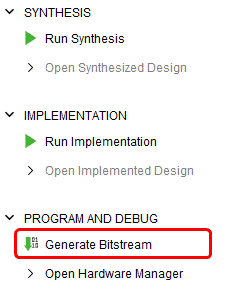
The bitstream can be generated for EagleCore in Vivado by following the steps below:
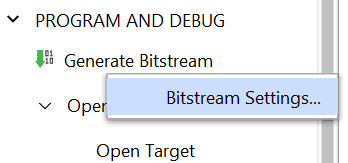
Step 1: It is recommended to generate .bin file along with .bit file. Right-click on “Generate Bitstream” under the “Program and Debug” section of the Flow Navigator window and click “Bitstream Settings”.
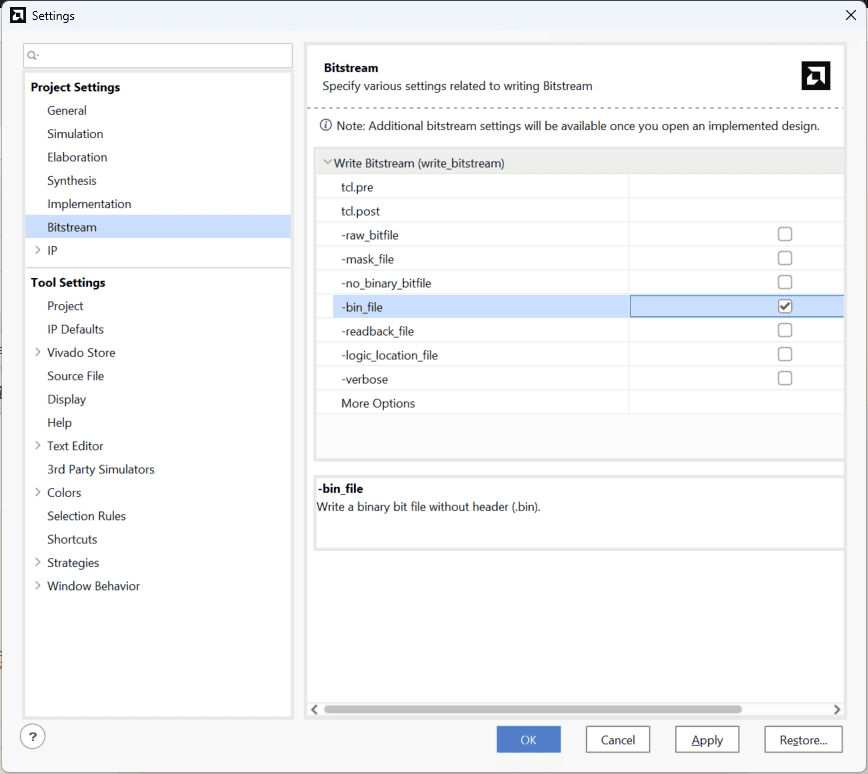
Step 2: Select “-bin_file” option in the dialog window and click “Apply” and then “OK”.
Step 3: Finally click “Generate Bitstream”.
Programming Eaglecore SOM Module Using USB-JTAG
Ensure that the D2XX drivers are installed prior to programming. The channel A of FTDI FT2232H chip on Eaglecore SoM board is connected to the JTAG interface of the FPGA. Through this connection, USB interface can be used as a JTAG programmer, eliminating the need for a dedicated JTAG cable or connector. Following steps illustrate how to program FPGA on Eaglecore ZU-Plus SoM using USB.
- Ensure that Switch PGM_SEL is set to USB and Connect the USB Type-C cable to the FPGA board.
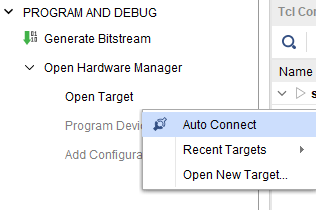
- Click on “Auto connect” under hardware manager and it will automatically establish the connection.
Programming EagleCore SOM Using JTAG
EagleCore ZU-Plus MPSoC SOM facilitates easy reprogramming of SRAM and onboard SPI flash through JTAG programmer like “AMD Platform cable USB”. Following steps illustrate how to program FPGA on EagleCore using JTAG.
Step 1: By using JTAG cable, connect AMD platform cable USB to the carrier of EagleCore and power it up.
Step 2: Open Vivado project and open the target by clicking on the “Open Target” in “Open Hardware Manager” in the “Program and Debug” section of the Flow Navigator window. Select “Auto Connect”.
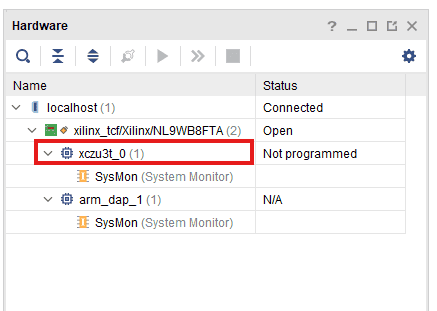
Step 3: If the device is detected successfully, then select “Program Device” after right clicking on the target device “” as shown below.
Step 4: In the dialog window which opens up, Vivado automatically chooses the correct bitstream file if the design was synthesized, implemented and bitstream generated successfully. If needed, browse to the bitstream which needs to be programmed to FPGA. Finally, click “Program”.
Programming QSPI Flash
Programming the QSPI Flash for the Zynq and ZynqMP series is slightly different than Series-7 FPGAs. There is a tutorial on how to boot EagleCore ZU from QSPI. Follow the same steps for EagleCore module also.
Link:Getting Started with PCIe on the Zynq UltraScale+ PS Section
Technical Specifications
Parameter * Value Unit
Basic Specifications
Number of GPIOs 179
On-board oscillator frequency 33.33 MHz
On-board oscillator frequency (DSC1001DI5-100.0000) 100 MHz
DDR3 Capacity 2 GB
Quad SPI Flash Memory (2 x MT25QU0512MBB8E12-0AAT) 1 Gb
Power supply voltage (External) 5 V
Programmable Logic Specifications
Internal supply voltage relative to GND -0.5 to 1.0 V
Auxiliary supply voltage relative to GND -0.5 to 2.0 V
HD supply voltage relative to GND -0.5 to 3.4 V
HP supply voltage relative to GND -0.5 TO 2.0 V
Processing Section Specifications
PS MIO I/O supply voltage (VCCO_MIO) -0.5 to 3.6 V
PS MIO I/O input voltage -0.5 to VCCO_PSIO + 0.55 V
PS DDR I/O input voltage -0.55 to VCCO_PSDDR + 0.55 V
Temperature -20 to 70 Degree Celsius
Maximum Processor Frequency 533 MHz
*All parameters considered nominal. Numato Systems Pvt Ltd reserves the right to modify products without notice.
Mechanical Dimensions
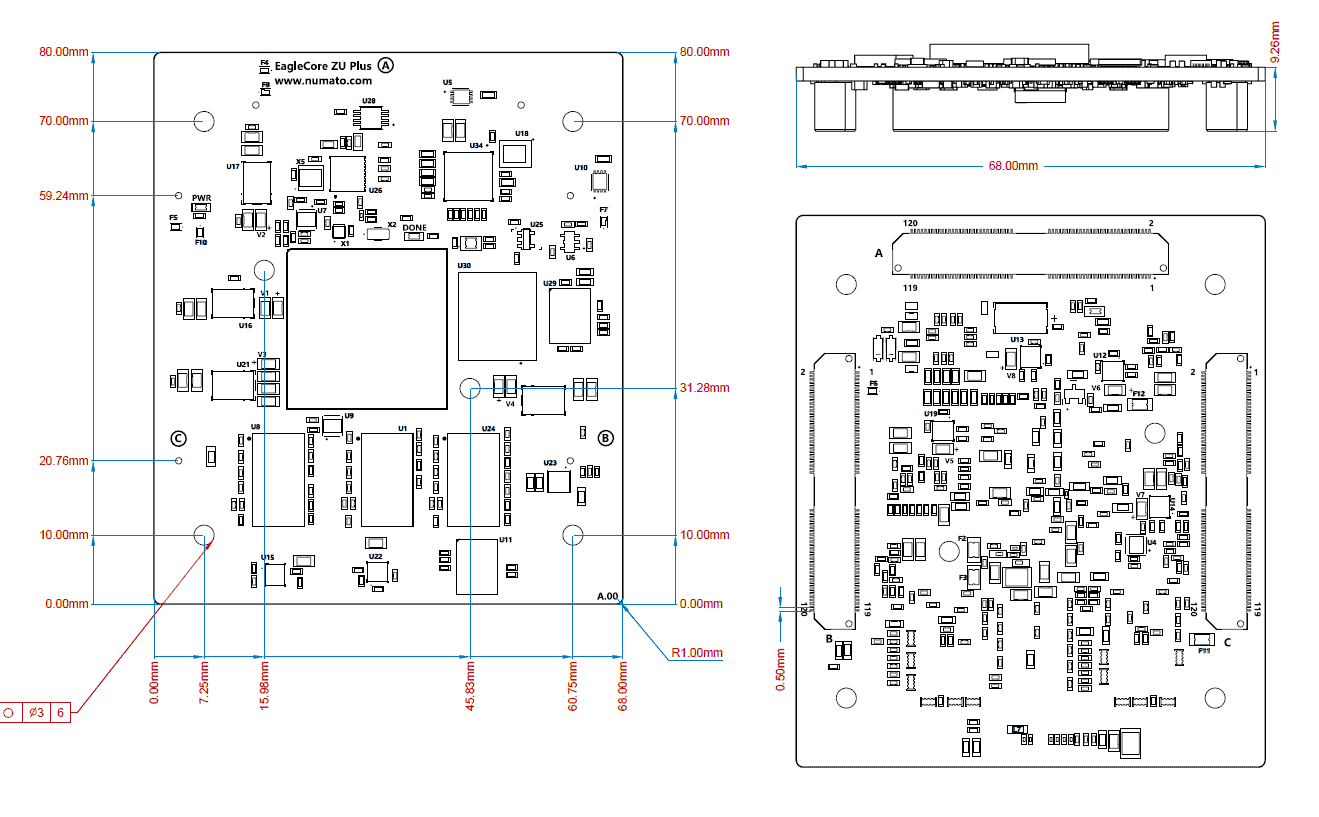
EagleCore ZU-Plus MPSoC SOM
0 views November 3, 2023 admin 0
